Young voters are the most concerned about housing supply and affordability heading into Quebec’s election
Two thirds of Gen Z voters say a candidate’s position on tackling the housing crisis will influence their vote
 MONTREAL, September 29, 2026 –With voters heading to the polls next week, housing concerns are top of mind for many Quebecers. According to a recent Royal LePage® survey, conducted by Burson,[1] more than a third (35%) of adults in the province of Quebec rank housing supply and affordability in the top three ballot box issues this provincial election. Not surprisingly, that figure is even higher among the youngest voters, jumping to 45% of Gen Z Quebecers.
According to the survey, housing issues are also top of mind for those who do not currently own a home. Among renters, 58% of respondents say that housing supply and affordability ranks in the top three major issues, compared to just 19% of homeowners.
“The results of this survey confirm that housing-related concerns are shaping how young Quebecers plan to vote, and that is telling about the future they see for themselves,” said Dominic St-Pierre, senior vice president of business development, Royal LePage. “If affording a home – whether owned or rented – feels increasingly out of reach, it could impact how members of our youngest generation approach major life decisions when planning for the future.”
Voters have several other major concerns which could define the outcome of this provincial election. When asked to identify the most important issues they’d like to see prioritized by the next Quebec government, the cost of living and inflation is ranked as the number one issue (74%), followed by healthcare and social services (68%).
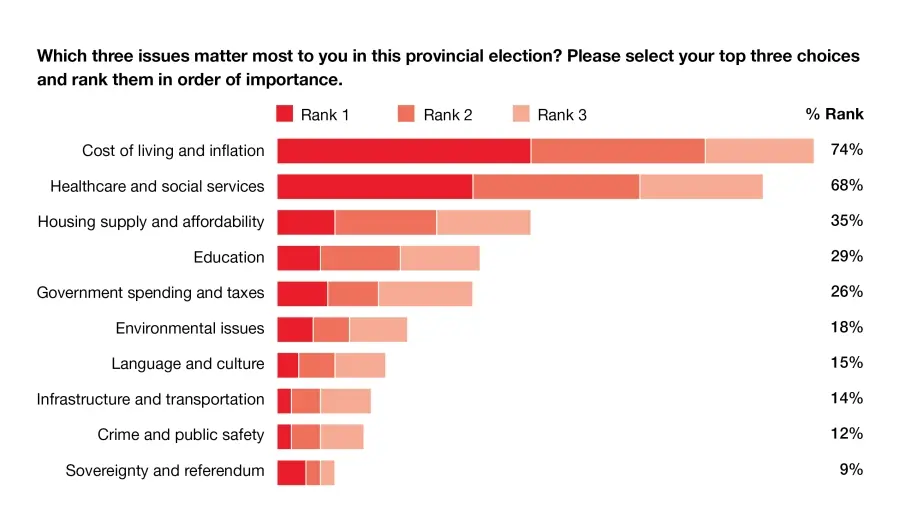
Cost of living and inflation voters’ top election issue
When asked which election issues were most important overall, 42% of voters selected housing, after the rising cost of living (78%), healthcare (73%) and education (45%). Quebecers are also concerned about government spending (38%), environmental issues (32%) and language and culture (30%). Respondents could select more than one answer to this question.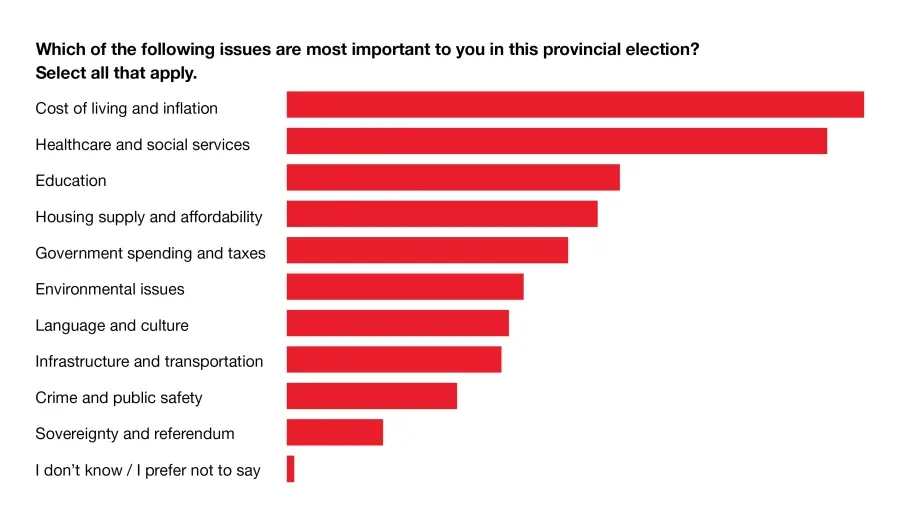 “These results reflect a broader reality: no provincial election is decided by a single issue, and this one, playing out against a backdrop of ongoing international trade tensions and economic uncertainty, is no exception. Housing, however, remains a significant factor for voters,” noted St-Pierre.
Housing policy has been a central topic of discussion during the leaders’ debates throughout this campaign. When asked if a party or candidate’s position on tackling the current housing supply and affordability crisis will influence their vote in the upcoming election, 42% of all respondents said yes. Once again, the youngest voters skewed higher than the provincial average, with 66% of Gen Z answering yes. Overall, 36% of voters say it will not influence their vote, while 22% are unsure or prefer not to say.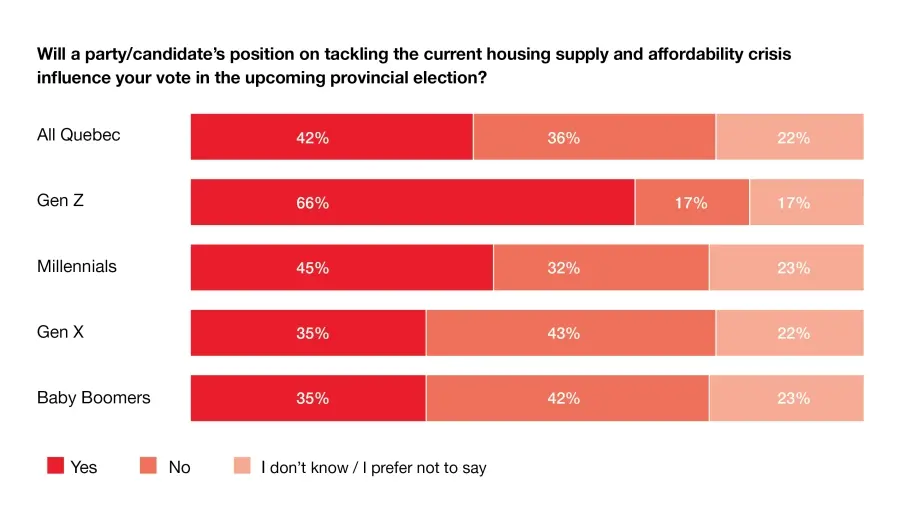 Rental costs a major concern
Across Canada, the province of Quebec has, by far, the highest proportion of renters. And, housing is an important ballot box issue for this segment of the population. When asked which provincial housing issue is of greatest concern, 47% of renters in Quebec selected annual rent increases, followed by finding an affordable rental property (25%).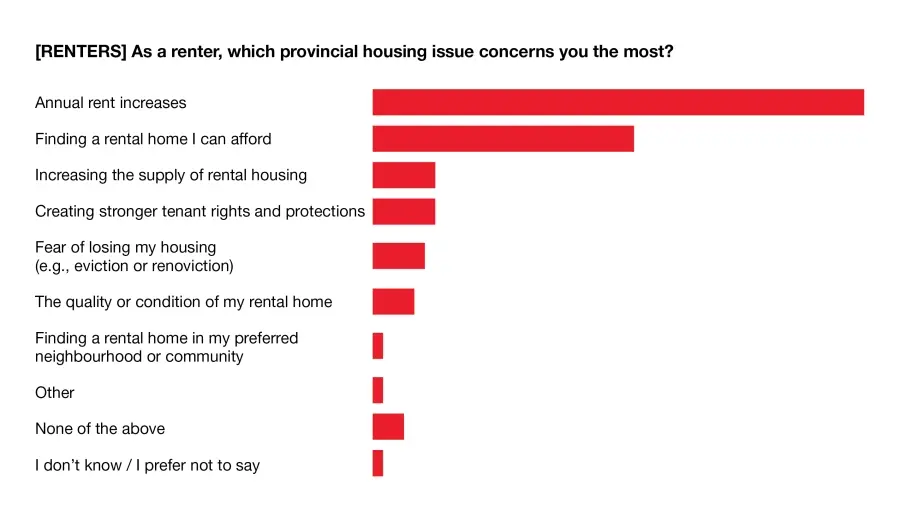
“Shelter is a basic necessity, and for a large share of Quebecers – particularly renters and young voters – a party’s commitment to tackling housing affordability will matter when they cast their ballots. Whoever is elected to lead the province for the next four years will be tasked with ensuring that the housing needs of Quebecers are attainable long-term,” concluded St-Pierre.
Quebec residents head to the polls on October 5th. You can read about each major political party’s election platform here: Coalition Avenir Québec (CAQ), Parti Québécois (PQ), Québec Solidaire (QS), Quebec Liberal Party (PLQ), Conservative Party of Quebec (PCQ).
For the full Royal LePage 2026 Quebec Election Survey chart, click here.
Download the Royal LePage 2026 Quebec Election Survey: rlp.ca/table-2026-Quebec-election-survey
About the Survey
Burson used the Leger Opinion online panel to survey 1,000 residents of Quebec aged 18+. The survey was completed between September 2nd and September 9th, 2026. Weighting was applied to ensure representation at an age, gender and regions of Quebec, based on 2021 census figures. No margin of error can be associated with a non-probability sample (i.e., a web panel in this case). For comparative purposes, though, a probability sample of 1,000 respondents would have a margin of error of ±3%, 19 times out of 20.
About Royal LePage
Serving Canadians since 1913, Royal LePage is the country’s leading provider of services to real estate brokerages, with a network of approximately 20,000 real estate professionals in over 650 locations nationwide. Royal LePage is the only Canadian real estate company to have its own charitable foundation, the Royal LePage® Shelter Foundation™, which has been dedicated to supporting women’s shelters and domestic violence prevention programs for more than 25 years. Royal LePage is a Bridgemarq Real Estate Services® company, a TSX-listed corporation trading under the symbol TSX:BRE. For more information, please visit www.royallepage.ca.
Royal LePage® is a registered trademark of Royal Bank of Canada and is used under licence by Bridgemarq Real Estate Services®.
For further information, please contact:
Appolline Risacher
Burson on behalf of Royal LePage
appolline.risacher@bursonglobal.com
418-559-8930
[1]Burson used the Leger Opinion online panel to survey 1,000 residents of Quebec aged 18+. The survey was completed between September 2nd and September 9th, 2026.For more information, see About the Survey.
